Table of contents
Key Points
- Professional sound is essential in small churches not only to improve message intelligibility but also to enhance the worship experience, creating a more spiritual and immersive atmosphere.
- Proper selection and installation of integrated sound systems and specific equipment (such as suitable microphones and speakers) are key to ensuring even sound distribution reaching all corners of the church.
- Optimal setup and positioning of equipment are essential to eliminate acoustic issues like echo and reverberation, ensuring that both speech and music are clear and rich for the entire congregation.
- Training church staff in handling and operating the sound equipment is crucial to maximizing the system’s capabilities and maintaining a high-quality auditory experience during religious services.
- Consulting with sound professionals can provide personalized and effective advice, optimizing the investment in sound technology and enhancing audio quality in the religious space.
Importance of Professional Sound in Small Churches
 Capilla Hacienda Las Marías, sonido por Renkus-Heinz
In small churches, sound quality becomes not only a technical component but also a spiritual one, significantly enhancing the religious experience for attendees.
Benefits of Investing in a Good Sound System
Investing in a professional sound system brings multiple benefits beyond simple audio amplification. First, it improves message intelligibility; every word spoken by the religious leader comes through clearly to all corners of the venue, ensuring that the spiritual message is understood without distortion or interference. This is crucial during sermons or important readings where every detail matters.
Additionally, a good sound system allows for even distribution of audio, eliminating dead zones where hearing was previously difficult. This ensures that every worshipper, regardless of their location within the church, receives the same auditory quality. It also helps reduce vocal fatigue for those leading services by not having to unnecessarily raise their voices.
Last but not least, equipping a church with proper technology enhances musical and choral presentations. Hymns and songs performed during the service take on a new dimension when reproduced with clarity and acoustic fidelity.
How Sound Contributes to the Religious Experience
Sound plays a fundamental role in how we experience any event; this is even truer in the religious context. An appropriate sound system creates an immersive environment that can lead worshippers to a deeper and more emotional connection during the service.
Music and religious chants serve as vehicles for expressing faith and devotion; with good acoustic support, these elements have the emotional power to deeply touch the hearts and souls of those participating in the service. Proper playback helps keep the collective spirit high and inspires greater participation among attendees.
In summary, having a professional sound system is indispensable for any small church looking to improve both the understanding and overall appreciation of the relative service by its faithful. We understand this need and urge all communities to seriously consider this vital aspect to enhance their collective religious experience.
Basic Considerations for Sound in Small Churches
Understanding the Acoustic Needs of Your Space
We recognize the importance of first assessing the specific acoustic needs of each small church. Each space has its own shape, size, and construction materials, factors that directly influence how sound propagates. It is crucial to conduct an initial acoustic analysis to identify problem areas and determine the most suitable sound system type. This step ensures that messages are conveyed clearly and that music complements, rather than competes with, the spiritual experience.
Echo and Reverberation
Echo and reverberation can significantly distort sound in enclosed spaces, making it difficult to understand words or clear musical notes. In small churches, these phenomena must be handled carefully due to their reduced dimensions. Implementing sound-absorbing materials in strategic points can minimize these undesirable effects without compromising the venue’s aesthetics. Additionally, properly adjusting the location and orientation of speakers plays a crucial role in reducing echo and reverberation.
Intelligibility
Intelligibility is essential to ensure that worshippers understand every word during religious services. A good sound system must maintain audio quality that allows words to be clearly distinguished no matter where someone is within the venue. This requires even volume distribution and balanced frequencies to avoid dead zones or overly noisy areas within the sacred space.
Key Factors in Choosing Sound Equipment
Selecting suitable equipment involves considering several key factors:
- Power: Sufficient to fill the space without saturating it.
- Clarity: Quality must be preserved at any volume.
- Directionality: Speakers should be directed towards where the worshippers gather to maximize direct sound absorption.
- Flexibility: Ideally, the system will allow adjustments for different types of services or events.
- Professional Installation: We always recommend professional installers specialized in ecclesiastical acoustics.
By completing our thorough evaluation and implementation based on these basic considerations, we ensure not only a religious service where everyone can hear clearly but also a deeper and more immersive spiritual experience for all attendees in small churches.
Essential Equipment to Enhance Sound
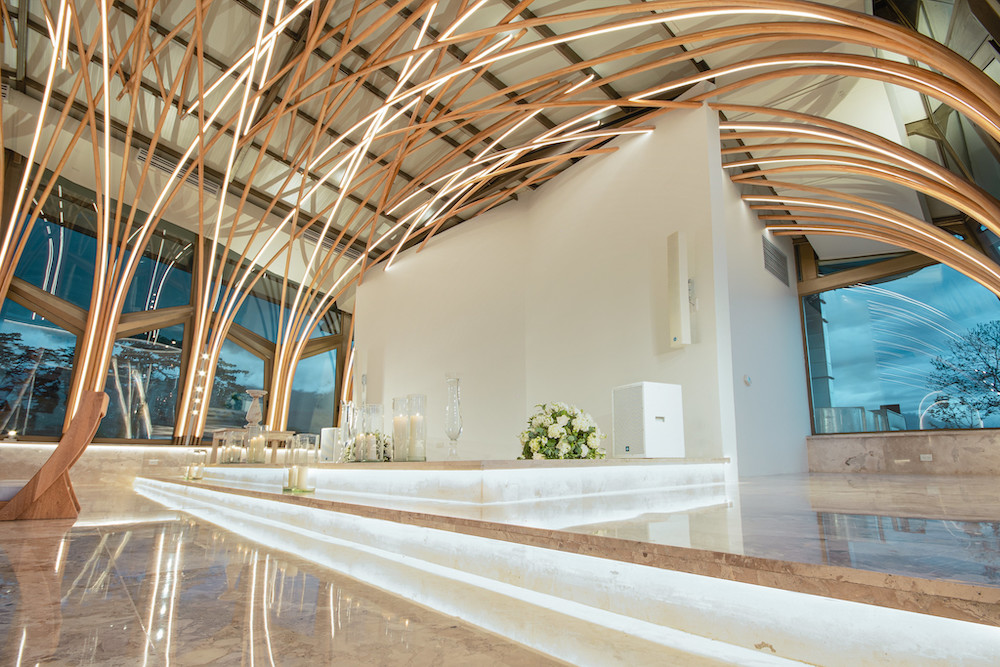
Parlantes Renkus-Heinz en el proyecto Capilla Hacienda Las Marías
Professional sound plays a crucial role in the religious experience within small churches. Below are the essential recommendations for equipping these sacred spaces with the best possible sound.
Integrated Sound Systems: An Effective Solution
Integrated sound systems offer a comprehensive and effective solution for small churches. These systems combine amplifiers, mixers, and signal processors into a single unit, making them easy to use and optimizing sound quality. Integration allows for simpler setup and eliminates compatibility issues between different devices. Additionally, they take up less space, a fundamental aspect in churches with limited areas.
Selection of Suitable Microphones and Speakers
The correct choice of microphones and speakers is vital to ensure message clarity. For microphones, we prefer models with cardioid or supercardioid polar patterns that minimize ambient noise and focus on the main sound source. Regarding speakers, we recommend those specifically designed for acoustically challenging spaces like small churches. Speakers should provide uniform coverage throughout the venue, ensuring that every worshipper receives the same level of auditory quality.
Signs It’s Time to Upgrade Your Sound System
Identifying the right time to upgrade the sound system is key to maintaining optimal auditory experience. Some signs include:
- Intelligibility Difficulties: If congregants have trouble understanding messages or music sounds distorted.
- Frequent Technical Failures: Constant interruptions or malfunctioning of the current equipment.
- Spatial Changes or Congregational Growth: Structural modifications in the church or a significant increase in the number of attendees may require adjustments to the system.
- Outdated Technology: When equipment no longer adapts to available new technologies or lacks modern features like wireless connectivity.
Recognizing these signs in time allows us to act before they negatively affect the religious experience. A good sound system not only enhances the spiritual atmosphere but also strengthens the connection between worshippers and their beliefs through a clear and powerful message.
Optimal Configuration and Positioning
Strategic Equipment Placement for Best Sound
We understand the importance of strategically placing sound equipment in small churches. To achieve professional sound, it is crucial to position speakers and microphones in locations that optimize their performance. Speakers should be placed at a height that allows sound dispersion throughout the area, avoiding dead zones where audio does not reach clearly. This distribution ensures that everyone present enjoys a uniform and rich auditory experience.
Microphones, on the other hand, need to be positioned near the sound source, such as the pulpit or the musical area, to accurately capture vocals and instruments. Proper positioning reduces the need to excessively raise the volume, decreasing the chances of acoustic feedback.
Positioning of Speakers and Microphones
Optimal positioning involves more than just raising speakers; it’s about directing them correctly towards the audience. Speakers should face the center of the congregation at an angle that covers the entire space without causing unwanted echoes. In small churches, it’s often effective to use wall or ceiling-mounted speakers with the ability to adjust their direction.
For microphones, we recommend using cardioid or supercardioid patterns for sermons or solo musical performances, as these patterns capture front sounds while minimizing ambient noise. In group settings like choirs or bands, using omnidirectional microphones ensures balanced sound capture from all directions.
Importance of Calibration and Sound Testing
Calibration is essential to adapt each piece of equipment to the church’s specific environment. This process adjusts individual levels and overall equalization to compensate for unique acoustic variations in the space. We conduct thorough tests before the religious service to identify potential issues such as prolonged reverberations or areas with inadequate coverage.
During these tests, we simulate different operational scenarios including spoken sermons and live music to assess how each system element responds under variable conditions. This allows us to make final adjustments, ensuring uninterrupted service where every word and musical note reaches every congregation member clearly.
By integrating these key elements: strategic location, precise positioning, and meticulous calibrations, we create immersive and inspiring auditory environments conducive to deep spiritual growth in any small church.
Training and Counseling in Professional Sound
The Importance of Church Staff Training
We understand that a professional sound system, no matter how advanced, is only as good as the people operating it. Therefore, adequate training of the sound personnel in small churches becomes an imperative need. This training allows operators to make the most of the equipment’s capabilities, make precise adjustments, and efficiently troubleshoot technical problems.
Workshops, courses, and online resources are presented as valuable options to acquire fundamental knowledge about sound techniques, equipment management, and acoustic optimization. Investing time and effort in this training ensures not only better sound during religious services but also a richer auditory experience for the congregation.
How to Find Specialized Professional Advice
Seeking specialized professional advice makes a notable difference in the sound quality within religious spaces. Audio experts can offer personalized recommendations based on the unique characteristics of each small church, from architectural design to the type of activities performed.
To find these professionals, we recommend initiating contacts through local or national associations dedicated to professional sound. Professional social networks and specialized forums also serve as ideal platforms to connect with recognized experts in the field. Additionally, companies dedicated to the sale or rental of sound equipment often provide technical consultancy as part of their services.
Opting for specialized advice not only immediately improves the audio quality but can also be cost-effective in the long run by avoiding unnecessary expenses on inadequate or poorly configured equipment. Our commitment is to ensure that every message reaches the community members clearly and strongly.
Conclusion
We understand the significance of professional sound in small churches and how it can completely transform the worship experience. We have explored together the keys to improving sound quality, from evaluating acoustic needs to staff training. We know that investing in a good sound system not only enhances message intelligibility but also enriches the spiritual atmosphere, creating a deeper connection between worshippers and the religious experience.
We understand that proper equipment selection and installation, along with a strategy of precise positioning and calibration, are essential to achieving an immersive auditory environment. And let’s not forget the importance of having professional guidance to guide us through this process, ensuring an intelligent and effective investment.
At the end of the day, our goal is to offer an unforgettable and profoundly meaningful spiritual experience for each attendee. With the information and recommendations provided, we hope you are one step closer to achieving that ideal in your small churches.
Frequently Asked Questions
Why is a good sound system important in small churches?
A quality sound system improves message clarity, enriches the worship atmosphere, and creates a more immersive and spiritual environment. This facilitates a stronger emotional connection between worshippers and the religious experience.
What benefits does investing in a quality sound system offer for churches?
Investing in a quality sound system in churches improves message intelligibility, ensures even audio distribution, and enhances musical performances, significantly contributing to the religious experience.
What are the basic considerations for sound in small churches?
Basic considerations include evaluating the acoustic needs of the space, managing echo and reverberation, ensuring sound intelligibility, and carefully choosing the appropriate sound equipment for the space.
Why is professional installation of sound systems in churches important?
Professional installation ensures that everyone can hear clearly during the religious service and contributes to a deeper and more immersive spiritual experience, avoiding technical issues and optimizing sound quality.
What essential equipment is recommended to enhance sound in small churches?
It is recommended to use integrated sound systems, carefully select microphones and speakers, and be attentive to signs indicating the need to upgrade the sound system to maintain optimal auditory experience.
How does strategic positioning of sound equipment affect the auditory experience in churches?
Strategic positioning of speakers and microphones ensures even sound dispersion and directs speakers towards the audience, significantly improving auditory perception and the spiritual experience of worshippers.
What is the importance of training the sound personnel in small churches?
Training the sound personnel allows them to make the most of the equipment’s capabilities, efficiently troubleshoot technical problems, and ensure proper sound management during religious services.
Why is seeking professional advice relevant to improve sound quality in religious spaces?
Seeking professional advice offers personalized recommendations, avoids unnecessary expenses on inadequate equipment, and ensures the implementation of effective solutions to significantly improve sound quality in religious spaces.
Our Portfolio

Apartment in Barranquilla: Home Automation and Lighting



Project KK: Where Art and Technology Converge

Designing the Sound and Visual Experience of Teriyaki Komodo Restaurant: A Case of Technological Innovation

The House in the Air: Technological Transformation

Chapel Hacienda Las Marías. The Evolution of Lighting in Worship Spaces


GP Apartment: Exceptional Design and Technology

Mutis Auditorium at Rosario University. The Greatest Acoustic Challenge We Have Faced.
Table of contents